
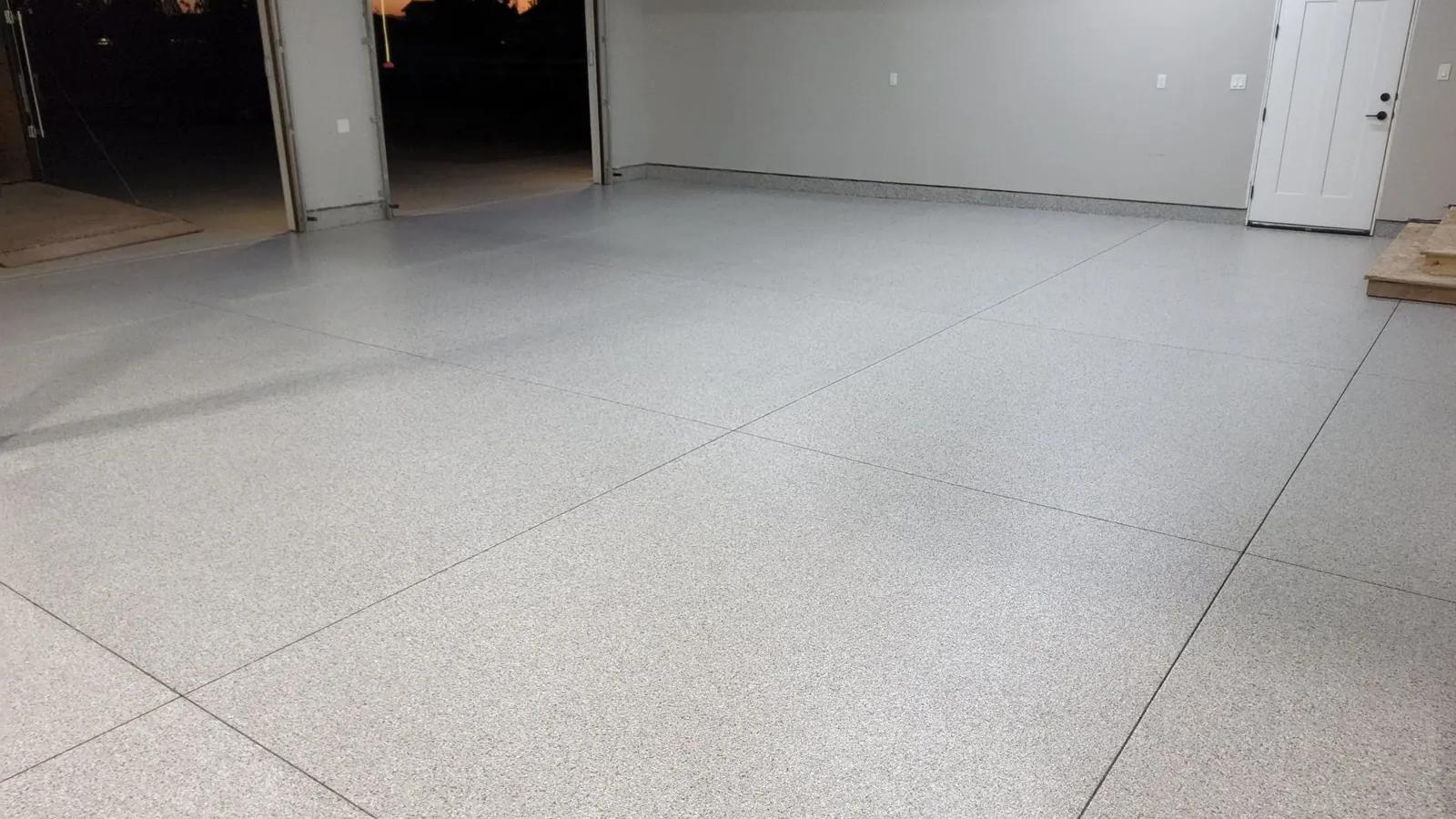
Almost every homeowner we meet asks the same question at the quote: should I just get epoxy? It is a fair question. Epoxy has been around for decades, the kits are on the shelf at every hardware store, and a fresh epoxy floor looks great the day it is finished. The trouble is what happens after that, especially in a climate like ours.
Here is how the two coatings actually compare, in plain terms, so you can decide what is right for your garage.
What Epoxy is
Epoxy is a two-part resin that hardens into a thick, rigid plastic layer on top of the concrete. It is strong against straight-down pressure, which is why it became popular in warehouses, and it can be tinted or finished with flake. Rigid is the key word. Epoxy does not flex, and it bonds to the surface of the concrete rather than deep into it.
Epoxy also takes its time. A proper epoxy floor usually needs several days between coats and before you can park on it, and it is picky about temperature and moisture while it cures. Most epoxy formulas are not UV stable either, so in direct sun the clear coat slowly turns yellow.
What Polyurea is
Polyurea is a newer family of coatings. It cures fast, it stays slightly flexible after it hardens, and when the concrete is ground open first, it soaks into the pores and locks on. That combination is what we install: a Penntek polyurea basecoat, a layer of decorative flake, and a polyaspartic clear topcoat that is UV stable and resists chemicals.
Penntek's own testing puts its system at four times stronger than epoxy, and the floor will not chip or peel. Because polyurea cures quickly, we finish most garage floors in a single day. You can walk on the floor within hours and park on it in about a day.
Why Idaho Makes the Difference
A coating that works in San Diego does not automatically work in Meridian. Three things about the Treasure Valley push hard on a garage floor:
- Freeze and thaw. Concrete expands and contracts as winter swings above and below freezing. A rigid coating cannot move with it, so it cracks and lifts. A flexible coating goes along for the ride.
- Road salt and de-icer. Everything your tires pick up in January ends up on the garage floor. The polyaspartic topcoat shrugs off salt, oil, and most household chemicals; epoxy stains and etches more easily.
- Summer sun and hot tires. July heat and tires straight off the freeway are the classic reason epoxy peels. The hot tire softens the coating and pulls it up. Polyurea bonded into ground concrete does not let go, and the topcoat will not yellow or chalk in the high-desert sun.
Side by Side
- Install time: epoxy, several days; polyurea, usually one day.
- Flexibility: epoxy is rigid and can crack with the slab; polyurea flexes with it.
- Sunlight: most epoxy yellows; the polyaspartic topcoat is UV stable.
- Hot tires: epoxy is known for peeling; polyurea will not chip or peel.
- Bond: epoxy sits on the surface; polyurea on ground concrete locks into the pores.
- Warranty: a store-bought epoxy kit comes with none; our residential floors carry a limited lifetime warranty.
When Epoxy Still Makes Sense
We would rather be straight with you than sell you a floor. If you have a detached shop that never sees a car, a budget that only stretches to a weekend kit, or a slab you plan to tear out in a couple of years, a DIY epoxy can get you a cleaner-looking floor for a while. Just go in knowing it is a short-term finish, not a permanent one.
If the garage is attached to the house, you park in it every day, and you want to do this once, polyurea is the better buy. It costs more than a kit up front and it is the last time you will coat that floor.
What a White Cloud Install Looks Like
Our crew grinds the concrete with diamond tooling to open it up, repairs the cracks and pits that can be repaired, and vacuums as we go. Then the basecoat goes down, the flake is broadcast into it while it is wet, and the clear topcoat seals everything. Not every crack or pit can be fixed, and we will tell you which ones at the quote rather than after.
The result is a floor that is easy to keep clean, textured enough for safe footing, and built to look the same on day 10,000 as it did on day one.
Not sure which floor you have, or which one you need?
The fastest way to find out is a free quote. We come out, look at the slab, and tell you plainly what it needs. Call us at (208) 880-7191 or request your free quote online. Most garage floors are finished in one day.